
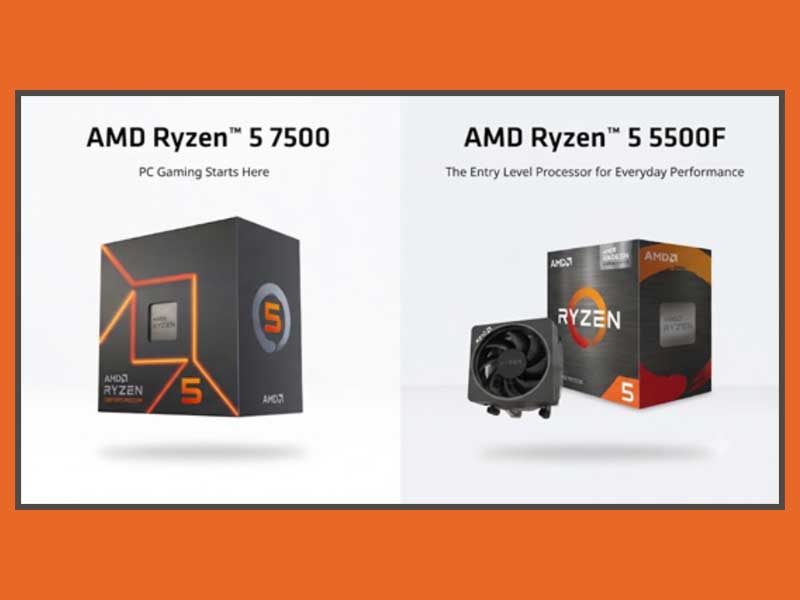
AMD Quietly Launches Ryzen 5 7500 and Ryzen 5 5500F, Starting at Just $99
AMD has quietly expanded its desktop CPU lineup with two new entry-level processors: the Ryzen 5 7500 for the AM5 platform and the Ryzen 5 5500F for the AM4 socket. Neither chip received a major launch event or formal press announcement, but both are notable additions that show AMD is continuing to support users across its current and previous-generation platforms.
The two processors target very different buyers. The Ryzen 5 7500 brings Zen 4 to AM5 with a basic integrated GPU, while the Ryzen 5 5500F gives budget-conscious AM4 users another affordable Zen 3 upgrade option.
Ryzen 5 7500 Brings Zen 4 to Budget AM5 PCs
The Ryzen 5 7500 is a six-core, 12-thread Zen 4 processor designed for AMD’s AM5 socket. It features a 3.7 GHz base clock, boost speeds of up to 5.0 GHz, 32 MB of L3 cache, 6 MB of L2 cache, and a 65W TDP. The chip also has an unlocked multiplier, allowing users to take advantage of features such as Precision Boost Overdrive.
Its biggest difference from the Ryzen 5 7500F is the inclusion of an integrated GPU. The Ryzen 5 7500 features a small RDNA 2 graphics unit with two Compute Units, running at around 2.2 GHz.
Don’t expect it to replace a dedicated graphics card. The integrated GPU is primarily intended for basic desktop use, multimedia playback, troubleshooting, and running a display without a discrete GPU. That makes the Ryzen 5 7500 particularly appealing for office PCs, compact systems and budget workstations where a dedicated graphics card isn’t immediately necessary.
For gaming PCs that will always use a discrete GPU, however, the Ryzen 5 7500F could remain the better value if it is available at a lower price.
Ryzen 5 5500F Keeps AM4 Alive
AMD’s second new processor, the Ryzen 5 5500F, takes a different approach. It is a Zen 3 six-core, 12-thread CPU designed for the older AM4 platform. It has a 3.0 GHz base clock, up to 4.4 GHz boost, 16 MB of L3 cache and a 65W TDP.
As indicated by the “F” suffix, there is no integrated graphics, so users will need a dedicated GPU.
Interestingly, AMD lists the Ryzen 5 5500F as a Vermeer-based processor, unlike the existing Ryzen 5 5500, which uses the Cezanne design. The 5500F is therefore architecturally closer to processors such as the Ryzen 5 5600, although its 16 MB of L3 cache is significantly lower than the 32 MB offered by six-core Vermeer chips.
The 5500F does have one notable advantage over the existing Ryzen 5 5500: PCIe 4.0 support. The older 5500 is limited to PCIe 3.0. For AM4 owners, this could make the new chip an interesting upgrade, particularly for systems using PCIe 4.0 graphics cards or NVMe SSDs.
Pricing and Availability
AMD has priced the Ryzen 5 7500 at $189, while the Ryzen 5 5500F costs just $99. Both processors are currently listed for the US market.
The two launches highlight AMD’s continued commitment to both platforms. The Ryzen 5 7500 offers an affordable entry point into the newer AM5 ecosystem, while the Ryzen 5 5500F gives millions of existing AM4 users another inexpensive upgrade path without requiring a new motherboard and DDR5 memory.
For buyers building a new budget PC, the Ryzen 5 7500 looks like the more forward-looking option. For existing AM4 systems, however, the $99 Ryzen 5 5500F could prove particularly attractive.